Better Study Skills. Stronger Thinking. Greater Ownership of Learning.
We spend years telling students what they need to learn. But how much time do we spend teaching them how to learn?
Students are expected to listen, take notes, complete assignments, prepare for examinations, remember information, and apply what they have learned.
Yet many enter classrooms without ever being systematically taught the practical skills these expectations require.
Some struggle to organize information. Others spend hours studying without knowing whether they understand the material. Still others memorize enough to pass an examination, only to forget what they learned shortly afterward.
These challenges do not necessarily reflect a lack of intelligence, motivation, or potential.
Sometimes, students simply haven't been taught an effective process for learning.
Student Venture is a learning methodology within Raising Royalty that helps people develop the intellectual skills and habits necessary to become more effective, independent, and lifelong learners.

Not Tutoring. Learning How to Learn.
A Methodology for Lifelong Learning
Tutoring generally helps students understand a particular subject. Student Venture helps students develop the skills they need to learn across subjects. Tutoring helps students learn the lesson. Student Venture helps students learn how to learn. That distinction is central to our approach. A student struggling with mathematics may need help understanding fractions. Another may need support interpreting a reading assignment or preparing for a science examination. Those are important instructional needs. But what happens when the next lesson begins, the subject changes, or the tutor is no longer available? Student Venture focuses on developing transferable learning skills: how to listen effectively, organize information, take meaningful notes, study with purpose, evaluate understanding, and apply knowledge. These skills help learners become more capable of directing their own learning while recognizing when additional instruction or support is needed.
Our purpose is not simply to help students succeed with today's assignment. It is to equip them with learning skills they can use tomorrow and throughout their lives.
The Roots of Student Venture
A Father's Desire to Help His Children Learn
Student Venture began with a father trying to help his children succeed in school. When his children were young, Darryl Johnson purchased Dan Basmagian's The Simple Way to an A, a study system emphasizing organized note-taking, regular review, and practical learning strategies. What began as an effort to support his own children became part of a larger understanding of education and personal development. Students need more than information. They need practical methods for receiving it, organizing it, understanding it, remembering it, and using it. Those early lessons became the foundation for Student Venture, now incorporated into the Raising Royalty framework. As the framework developed, Student Venture found its place within a larger understanding of wisdom.
Learning how to learn is not simply an academic skill. It is part of developing the intellectual capacity necessary to navigate life.
Student Venture and the Wisdom of the Knight
Developing the Intellectual Capacity for Wise Decisions
Within Raising Royalty, the Knight represents Wisdom. Wisdom involves more than possessing information or knowing the correct answer. It requires the ability to understand circumstances, evaluate possibilities, recognize consequences, and make thoughtful decisions. Raising Royalty approaches the development of wisdom through two complementary dimensions:
- Intellectual Development — Student Venture Student Venture strengthens our ability to acquire knowledge, organize information, think critically, evaluate evidence, connect ideas, and apply what we learn. It helps develop the intellectual understanding necessary to make informed decisions.
- Social-Emotional Development — Understanding Ourselves and Others Social-Emotional Learning develops self-awareness, emotional regulation, empathy, relationship skills, and responsible decision-making. It helps us recognize how our emotions, attitudes, experiences, and relationships influence our choices.
These two dimensions work together. A person may possess considerable knowledge but struggle to manage anger, consider another person's perspective, or respond appropriately under pressure. Another may demonstrate emotional maturity but lack the information or analytical skills necessary to understand a complicated situation. Neither intellectual ability nor emotional maturity alone guarantees wise decisions.
Student Venture helps us develop what we know and how we learn. Social-Emotional Learning helps us understand ourselves and others as we put that knowledge to work.
Together, they strengthen our capacity for wisdom.
Knowing What to Do Is Not the Same as Doing It Wisely
The Knight moves differently from every other piece on the chessboard. Its unusual movement reminds us that navigating life requires flexibility, perspective, and the ability to recognize possibilities that may not be immediately apparent. Wise decisions require more than finding the correct answer. They require understanding the circumstances, considering the people involved, recognizing our emotional responses, anticipating consequences, and choosing an appropriate course of action.
Intellectual development helps us understand the board. Social-emotional development helps us navigate the people, pressures, and emotions involved in making our next move.
Student Venture concentrates on the intellectual side of that development while recognizing its relationship to the whole person.
Wisdom is not simply what we know. It is how thoughtfully we apply what we know.
Learning Is a Skill We Can Develop
From Receiving Information to Understanding It
Learning is not simply the accumulation of facts. It involves recognizing important information, connecting new ideas with what we already know, asking meaningful questions, and developing the ability to apply our understanding. Student Venture introduces a practical learning process:
Listen. Organize. Review. Reflect. Apply.
Listen — Receive Information Intentionally
Effective learning begins with attention. Students learn to listen for important ideas, recognize supporting details, identify questions, and distinguish between hearing information and understanding it. Listening also requires recognizing when something is unclear and being willing to ask for clarification.
Organize — Give Information Structure
Information becomes easier to study when it is organized. Students develop note-taking and information-management practices that help them identify main ideas, supporting details, relationships, and areas needing clarification. Organizing information also helps learners recognize how individual concepts fit into a larger subject.
Review — Strengthen Understanding and Retention
Learning rarely happens through a single exposure. Regular review helps students revisit information, recognize what they remember, identify what they have forgotten, and strengthen their understanding over time. Review becomes more effective when students practice recalling and explaining information rather than simply rereading it.
Reflect — Think About What You Are Learning
Reflection moves students beyond memorization. They learn to ask questions, examine assumptions, connect ideas, explain concepts in their own words, and evaluate their understanding. Reflection also helps learners recognize when their current approach is not producing the results they need.
Apply — Put Knowledge to Work
Learning becomes more meaningful when students can use what they know. Application involves solving problems, making decisions, explaining reasoning, and transferring knowledge into new situations. It is one thing to remember a principle. It is another to recognize when and how that principle applies.
The goal is not simply to help students complete assignments. It is to help them become more capable and independent learners.
The Skills Behind Successful Studying
Practical Tools Students Can Use Every Day
Student Venture focuses on learning practices that can support students across subjects, grade levels, and learning environments.
These include:
- Active Listening: Recognizing important information and asking questions when understanding is incomplete.
- Effective Note-Taking: Recording and organizing information so it can be reviewed and understood.
- Study Planning: Managing assignments, study time, priorities, and preparation.
- Regular Review: Revisiting material intentionally rather than relying entirely on last-minute studying.
- Reading for Understanding: Identifying main ideas, supporting information, and connections between concepts.
- Critical Thinking: Examining information, evaluating evidence, and developing sound conclusions.
- Synthesis: Bringing separate ideas together to form a clearer understanding of the whole.
- Self-Assessment: Recognizing what has been learned and what still needs attention.
- Reflection and Application: Connecting learning with decisions, experiences, and practical challenges.
These skills are useful in school, but their value does not end at graduation. Adults use them when learning new responsibilities, preparing for careers, managing information, solving problems, and adapting to changing circumstances.
Learning how to learn is a lifelong developmental skill.
From Studying Harder to Studying Smarter
Understanding the Difference
A student may spend hours reading a textbook without retaining much of the information. Another may repeatedly copy notes without understanding the concepts they contain. Someone else may believe they understand a lesson because the material looks familiar, only to struggle when asked to explain it independently. Time spent studying matters, but time alone does not guarantee learning. Student Venture encourages learners to examine not only how long they study, but how they study. Can they identify the most important ideas? Can they explain those ideas without looking at their notes? Can they connect new information with something they already understand? Can they recognize what they do not yet know? Can they use what they have learned to solve a problem? These questions help students move from simply completing study activities toward evaluating whether learning is actually taking place.
Effective studying is not simply about putting in more time. It is about learning how to make that time more productive.
Critical Thinking and Synthesis
Learning to See the Bigger Picture
One of the most important intellectual skills we can develop is the ability to bring information together. Students often encounter knowledge in separate lessons, subjects, and assignments. But life rarely presents its challenges in neatly divided categories. Solving problems requires us to recognize relationships between ideas, examine different perspectives, and consider how individual pieces of information contribute to a larger understanding. Critical thinking helps us evaluate what we encounter. Synthesis helps us connect what we have learned. Together, these skills support better questions, stronger reasoning, and more thoughtful decisions. For example, a student studying history may learn dates, names, and events. But deeper understanding develops when that student begins asking how those events were connected, what influenced the decisions people made, and how those decisions affected what happened next. The same process applies to science, mathematics, literature, and everyday life.
Knowing the individual pieces matters. Understanding how they fit together changes what we can do with that knowledge.
Learning Through Chess
From Information to Decisions
Within Raising Royalty, chess provides a practical environment for applying Student Venture's learning methods. Participants can learn to record moves using chessboard coordinates, organize observations, study patterns, examine decisions, and reflect on their strategies. The chessboard creates opportunities to practice several intellectual skills at once. Players must recognize the current position, consider available options, anticipate consequences, and select a move. Afterward, they can examine what happened and consider what they might do differently. They begin to recognize that improvement requires more than playing another game. It requires learning from the previous one. Chess also helps illustrate the relationship between intellectual development and social-emotional learning. A player may recognize the best move but become impatient. Another may understand a strategy but react emotionally after losing a piece. A third may need to reconsider an approach when an opponent makes an unexpected move. These experiences remind us that knowledge and judgment are related but distinct. Student Venture helps participants develop the intellectual skills involved in examining the board, evaluating possibilities, and learning from experience. The broader Wisdom framework also considers the emotional and relational capacities that influence how those skills are used.
Every move changes the board. Every learning experience offers an opportunity to grow.
Student Venture Within Raising Royalty
One Dimension of a Larger Developmental Journey
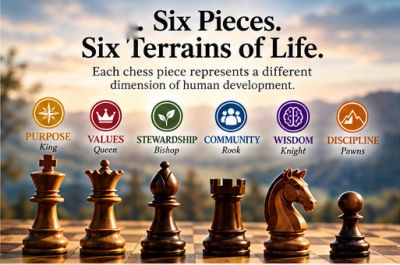
Raising Royalty uses six types of chess pieces to represent six interconnected dimensions of life:
King — Purpose
Understanding what matters and where we are going.
Queen — Values
Recognizing the principles that guide our decisions and conduct.
Bishop — Stewardship
Learning to manage our time, talents, treasures, attitude, and temple.
Knight — Wisdom
Developing intellectual understanding and social-emotional maturity to support sound judgment.
Rook — Community
Building healthy relationships and learning to contribute to the well-being of others.
Pawns — Discipline
Developing the habits and practices necessary to put our intentions into action.
Student Venture serves the intellectual-development dimension of the Knight. But the learning skills it develops can strengthen every part of the framework. Purpose gives learning direction. Values shape how we pursue knowledge and use what we learn. Stewardship challenges us to manage our time and abilities. Community reminds us that learning is strengthened through relationships and cooperation. Discipline helps us practice the habits necessary for continued improvement.
Student Venture has a specific role within Wisdom, but the benefits of learning how to learn extend across the whole of life.
Helping Students Take Ownership
From Dependence Toward Independence
Parents, teachers, mentors, and tutors can provide valuable support. But one of the greatest gifts we can give a learner is the ability to take increasing responsibility for their own learning. That begins when students learn to ask: What am I supposed to understand? What do I already know? What information am I missing? What strategy will help me learn this? How will I know when I understand it? What should I do when my current approach isn't working? These questions encourage learners to become active participants rather than passive recipients of instruction. Student Venture does not assume that every student learns in the same way or has access to the same resources. Different learners may need different supports, accommodations, opportunities, and amounts of practice. Becoming an independent learner does not mean never needing help. It means developing the ability to recognize what we need, use available resources, evaluate our progress, and take increasing responsibility for the learning process.
Our aim is to help each learner develop greater confidence, competence, and ownership of their learning.
Bringing Student Venture to Your School or Community
Workshops, Study Skills, and Learning Experiences
Student Venture provides a foundation for developing practical learning experiences for students, families, and educational partners. I'm Third Enterprises welcomes opportunities to collaborate with schools, after-school programs, community organizations, and families interested in strengthening learning skills.
Workshop Opportunities

Learning How to Learn
Explore the habits and strategies that support effective learning and greater independence.If customers can’t find it, it doesn’t exist. Clearly list and describe the services you offer. Also, be sure to showcase a premium service.
Effective Note-Taking
Learn to recognize, record, organize, and review important information.
Studying with Purpose
Develop practical approaches to study planning, preparation, review, and retention.Are your customers raving about you on social media? Share their great stories to help turn potential customers into loyal ones.
Reading for Understanding
Practice identifying main ideas, examining supporting information, and connecting concepts.Running a holiday sale or weekly special? Definitely promote it here to get customers excited about getting a sweet deal.
Critical Thinking and Synthesis
Strengthen the ability to evaluate information, recognize relationships, and bring ideas together.
Planning and Self-Assessment
Customers have questions, you have answers. Display the most frequently asked questions, so everybody benefits.
Workshops can be designed for young people or adapted for adults who want to strengthen their own learning practices.
Student Venture can also support parent engagement by helping families understand how to encourage effective learning habits at home.
Our approach emphasizes participation, practice, reflection, and the opportunity to apply skills to real learning challenges.
Student Venture can complement classroom instruction, tutoring, mentoring, and after-school programming without attempting to replace them.
Teachers teach subjects. Tutors provide additional subject support. Student Venture develops the learning skills students can carry from one subject to the next.
Let's Help Students Become Better Learners
Learning Skills That Last Beyond the Classroom
Imagine students who know how to organize their notes, plan their study time, ask better questions, evaluate their understanding, and recognize when they need help.Imagine parents who can support their children's learning without feeling responsible for knowing every answer.Imagine teachers whose students are increasingly equipped to engage with instruction, organize information, and take responsibility for their progress.These are the possibilities Student Venture seeks to develop.And within Raising Royalty, they contribute to something larger than academic achievement.They strengthen the intellectual foundation upon which wisdom can develop.We cannot learn every lesson for our children. But we can help them develop the skills to become lifelong learners.
Let's Explore Student Venture Together
Are you interested in helping students become more organized, confident, and independent learners?Let's discuss the learning challenges you are seeing and the opportunities we might develop together.Contact I'm Third Enterprisesinfo@imthird.org(734) 972-0902Developing People. Delivering Services. Building Systems.We're Putting the Neighbor Back in the Hood!